Average Number of Girls Born Each Year How Many Babies Born in United States Each Year

Final March, when the coronavirus outbreak took hold of public life and forced many Americans into their homes to quarantine, some speculated that more than fourth dimension together for couples – and, in some cases, obstacles to accessing contraception – could result in a baby boom. Now, however, early data is pointing toward a pregnant drib in fertility direct related to the pandemic, both in the United States and globally, in the coming years.
Some gauge that there will be shut to 300,000 fewer births in the U.South. in 2021 as a consequence of the outbreak. These conjectures are already coming to fruition based on conditional monthly estimates. Overall, the U.South. nascency rate dropped 4% in 2020 based on provisional data, and a look at December 2020 – the month when babies conceived at the offset of the pandemic would have been born – shows an 8% decline from the previous Dec, suggesting that women may have postponed pregnancies in response to the ongoing public health crunch.
This post contains updates from previously published posts, which were written by Gretchen Livingston, a former senior researcher at Pew Research Center. General fertility rates, teen birth rates and births to immigrant and U.Due south.-born women are based on data from the National Vital Statistics System of the National Center for Wellness Statistics (NCHS), which are extracted from completed nascency certificates. Completed fertility rates are derived from the U.S. Census Bureau's June Supplement of the Current Population Survey, which produces a nationally representative sample of the non-institutionalized population of the U.S. The June Fertility Supplement was first administered in 1976 and is typically conducted every other year. Most of the CPS files used in this study are from the Integrated Public Use Microdata Series (IPUMS-CPS) provided past the University of Minnesota. Public-employ information files prior to 1986 are not readily bachelor, so analyses of pre-1986 time points are drawn from Census Bureau tabulations.
Other advanced countries have also begun to feel declining nascence rates. Italy, Japan, French republic and Kingdom of belgium are among the nations that accept reported sudden drops in births about ix months after the start of the pandemic, compared with the previous yr. Some worry that a "baby bosom" will create societal age imbalances and strain health care and retirement systems while likewise somewhen stripping the economic system of young workers who tend to drive innovation and growth.
By economic downturns, including the Great Recession, have revealed a connexion between economic atmospheric condition, income and fertility. The coronavirus pandemic – and its associated recession – brought on increased unemployment, school and child care closures, isolation from social networks and fear about the future, all of which are factors some women may consider before getting pregnant.
While nosotros don't however know what long-term impact, if whatever, the pandemic volition take on fertility in the U.S., here are v key facts about the nation's contempo fertility trends earlier the pandemic began.
The general fertility rate in the U.S. was already at a record depression before the COVID-19 pandemic began. In 2019, there were 58.3 births for every 1,000 women ages xv to 44 in the U.Due south., downwards from 59.ane in 2018, making it the fifth sequent year in which the fertility rate declined. A multifariousness of factors have driven down the rate, including a decline in birth rates amongst women 34 and younger. The decrease as well likely reflects the lingering effects of the Great Recession, too as longer-term demographic changes such as increased educational attainment among women and delays in marriage.
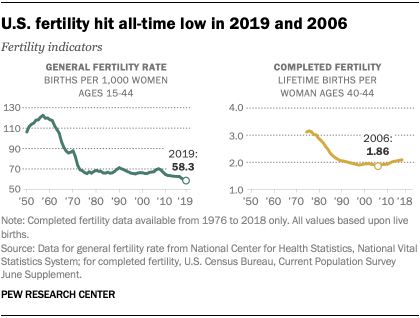
The completed fertility rate, or the number of children a woman has in her lifetime, tells a slightly dissimilar story. According to this mensurate, the low bespeak in U.S. fertility came in 2006, when women ages xl to 44 had given nascency to an average of one.86 children over the course of their lifetimes. Since 2006, the completed fertility charge per unit has been trending upward, and in 2018 the boilerplate was a petty over 2.0 children. It is important to annotation, however, that because the completed fertility rate is a lagging indicator, it doesn't reflect the fertility of young women today.
The share of American women at the end of their childbearing years who had e'er given birth was higher in 2018 than it had been a decade before. Some 85% of women ages 40 to 44 were mothers in 2018, upwards from 82% in 2008, according to a Pew Research Center analysis of Census Agency information. The increase in the share of women who had ever given birth, alongside the decline in the share having children in whatsoever given year, reflect the fact that women are having children later on in life. The median age when women become mothers in the U.S. was 26 in 2016, up from 23 in 1994.
There has too been a striking increase in motherhood among women ages 40 to 44 who take never been married. In 2018, roughly six-in-10 (59%) of never-married women in this age group had given nativity, most double the share in 1994 (32%).
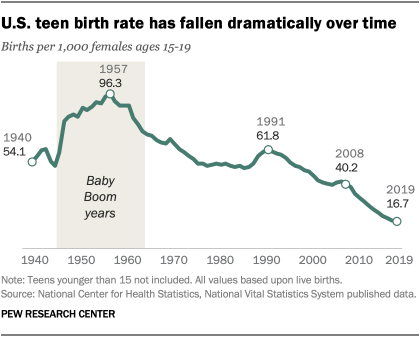
Teen birth rates accept fallen dramatically in contempo years. 1 factor that has contributed to the overall drop in annual fertility in the U.S. has been the falloff in births to teenagers. The teen nativity rate hit a record low in 2019, when there were sixteen.7 births per 1,000 girls and women ages 15 to xix. This was a 4% drop from the previous year and less than half the teenage birth charge per unit about a decade earlier (37.ix per 1,000 teens in 2009). The teen birth rate has fallen across all major racial and ethnic groups, merely information technology remains higher amidst Hispanic and Blackness teens than amongst teens who are White or Asian. The bulk of teen births in the U.South. are to unmarried mothers.
The Corking Recession contributed to the overall birth rate decline, including teen births. Only given that the pattern has persisted well across the recession, experts besides attribute it to fewer teens having sexual practice, teens having access to more reliable birth control, and pregnancy prevention programs.
Birth rates take declined for U.South.-born and strange-built-in women. Still, immigrant women account for a disproportionate share of the nation'due south births amidst women ages 15 to 44. In 2017, 14% of the U.South. population was foreign built-in, simply 23% of all births were to immigrant women.

For decades, a large share of immigrant births in the U.S. were to mothers of Mexican descent (42% in 2000). Simply the demographic profile of new mothers has shifted in recent years every bit clearing patterns take changed. Specifically, immigration flows from Latin America accept slowed and Asian immigration is on the rise. As a consequence, only a quarter of U.S. immigrant births were to Mexican-born women in 2018. Amid immigrant women overall, half of all births in 2018 were to Hispanic women, down from 58% in 2000.
The education gap in fertility has narrowed in contempo decades. Historically, women with college levels of education have been less likely to get mothers. In 1994, 65% of women ages twoscore to 44 with a Ph.D. or professional degree were mothers, as were 76% of those with four-year college degrees. The shares were considerably higher among those with less instruction: 87% of women with some higher education and 88% of those with a high school degree or less were mothers.
In the last few decades, this gap has narrowed significantly. In 2014, 80% of women ages 40 to 44 with a Ph.D. or professional degree were mothers, as were 82% of those with a available'south degree. The shares remained steady during this flow amongst women with less educational activity. Beyond all teaching levels, the timing of maternity has shifted as fewer women are having children in their teens or early 20s.

Amanda Barroso is a former writer/editor focusing on social trends at Pew Enquiry Eye.
Source: https://www.pewresearch.org/fact-tank/2021/05/07/with-a-potential-baby-bust-on-the-horizon-key-facts-about-fertility-in-the-u-s-before-the-pandemic/
0 Response to "Average Number of Girls Born Each Year How Many Babies Born in United States Each Year"
Post a Comment